Your experts for consolidated financial statements.
Here you’ll find everything you need on the topic of consolidated financial statements—concise, clear, and to the point.


When traditional planning architectures reach their limits, what SAP truly enables with BDC (and Seamless Planning)—and how companies can pragmatically manage the transition toward the Autonomous Enterprise.
Planning is becoming faster, more interconnected, and more volatile—yet many companies are still using legacy BW-IP and BPC landscapes that have been optimized over the course of years (or decades). This often still works surprisingly well, but it’s difficult to integrate with future-oriented technologies in the cloud. SAP is currently addressing precisely these friction points with cloud architectures centered around the Business Data Cloud (BDC—including SAP Analytics Cloud (SAC) and SAP Datasphere)—including the Seamless Planning approach as a “real-time bridge” between planning and the data platform. With the Autonomous Enterprise strategy unveiled at Sapphire 2026, the horizon is shifting once again: away from AI as an assistant, toward AI as an active participant in the planning process.
This article clarifies what is already feasible today and what remains a future vision. It is based on insights from internal CALEO discussions about the future of planning—and on experience from projects where these very transitions are currently taking place.
BW-IP and BPC are mature technologies: processes are established, and users are trained. The largest investment was typically made during the initial implementation; day-to-day operations are dominated by manageable iterations: master data maintenance, hierarchy changes, new accounts, and minor optimizations.
This stability is real and economically valuable. Nevertheless, expectations are shifting. Today’s users are accustomed to getting quick explanations—“where does this number come from?”—ideally through fewer click paths and more assistance. While such convenience and assistance features can technically be retrofitted into older architectures, doing so requires considerable effort. Furthermore, even after years, gaps still emerge in frequently used functions because certain use cases were not fully thought through at the time. Every established technology carries such a “backpack” of minor legacy issues—and every new product will initially bring its own.
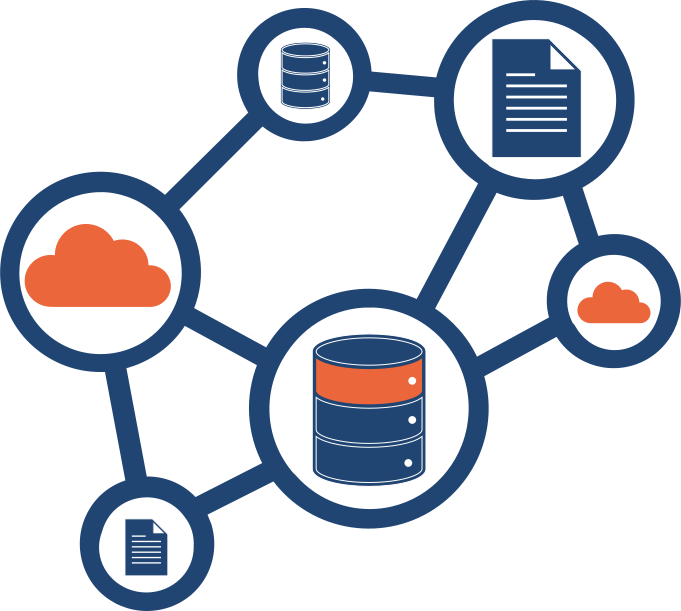
The core of Seamless Planning is quickly explained: SAC remains the planning and user interface—while planning data storage moves to the SAP Datasphere. SAC accesses models in the Datasphere via a live connection, rather than isolating planning data in separate, internal SAC models. This eliminates typical ETL steps between planning and reporting, and plan values are available for analysis immediately after entry. Pure planning logic is implemented in SAC; for additional transformations, the Datasphere’s more comprehensive toolkit can be used.
The impact is evident in the project: no data silos, no waiting time until data arrives and is consistent again. Users often spot inconsistent plan data directly in their actual reports—rather than first in an aggregated check report on the planning model.
As compelling as the target vision is—in practice, the devil is in the details, and that needs to be honestly acknowledged:
Whether it’s a greenfield project or the further development of an existing landscape: the choice of tools is rarely ideological—it’s scenario-driven. Several typical approaches can be derived from project realities:
A new, traditional BW system, on the other hand, would no longer be recommended for a greenfield scenario: too much complexity, too little future-proofing—especially if the business department and IT would first have to learn the technology.
Which architecture is ultimately the right fit depends on the business and technical circumstances: bottom-up or top-down, planning horizon and granularity, Excel dependencies, existing legacy systems, and the strategic S/4 and cloud roadmap. These parameters together paint the picture—not the latest trend.
Anyone operating an established BW-IP or BPC landscape is right to ask: At what point does the migration become worthwhile, and how can previous investments remain usable? The honest answer based on real-world experience: A complete “Big Bang” is rarely necessary or realistic. Often, a “Run & Innovate” approach works best—maintaining stable operations of existing systems while implementing new requirements in a targeted manner using Seamless Planning.
Keep in mind: Not every specialized scenario from the “old world” can be mapped 1:1 to SAC—even large organizations, and SAP internally, run multiple approaches in parallel. That’s why a partial migration based on clearly defined use cases is usually worthwhile: a new forecasting process, commentary and variance analyses, or a new planning domain. The company’s situation also matters: A company facing a sale or carve-out in the medium term will deliberately make more conservative decisions than a corporation with a long-term SAP roadmap. Key factors include the planning horizon and granularity, Excel dependencies, data harmonization, and the strategic S/4 and cloud roadmap.
Three questions to help you get started:
Currently, we view AI primarily as a way to streamline processes (predictive analytics, plausibility checks, faster forecast generation). SAP’s vision goes further: At Sapphire 2026, SAP unveiled the Autonomous Enterprise, powered by the SAP Business AI Platform and an Autonomous Suite featuring numerous Joule assistants and specialized agents. The message is a shift in roles—from AI as a productivity layer to AI as a participant that prepares or makes decisions within processes.
To this end, “agents” are intended to flexibly consolidate data from various sub-planning processes in the future—rather than companies “hard-coding” rigid integration chains and global planning models for years on end. The goal: less rigidity, more adaptability—and, of course, fewer manual tasks and more automation.
Here, it’s worth taking a sober look at the reality of project implementation, because SAP’s narrative contains an inherent tension: On the one hand, agents are supposed to flexibly tap into and transform any data sources; on the other hand, SAP simultaneously emphasizes the need for a harmonized database. These two aspects are not contradictory; rather, they constitute the actual work: Without clean semantics, metadata, and consistent granularity in a platform like Datasphere, agents lack the context needed to interpret data reliably. “Almost right” isn’t good enough in financial planning—and that’s precisely why a harmonized data foundation remains a prerequisite, not an afterthought.
Therefore, tangible assistance functions are the most realistic first step: summarizing comments and planning events, explaining anomalies, and suggesting appropriate input layouts. The obvious next step: If planning dimensions are consumed live from Datasphere in the future, agents could process fact tables from the planning model and link them to the reporting model. SAP’s vision of creating entire planning models via text descriptions is conceivable for simple cases—but complex corporate planning cannot be described in a single sentence. At that point, at the very latest, someone will again be needed who has a deep technical understanding of the model—and the appropriate prompts.
The bottleneck is shifting. It is not the choice of tool that matters, but rather the seamless interplay of process design, data model, semantics, and governance. This also changes the consulting landscape: away from pure custom coding, toward refining use cases, reducing complexity, and validating architectural decisions. If the “programming language of the future” is natural language, the value of precise requirements increases—because when specifications are vague, the old adage still holds true: garbage in, garbage out. On the developer side, AI-powered tools will simultaneously transform their own work—for example, in documentation, quality assurance, and within the ABAP Cloud and UI5 environments.
The Autonomous Enterprise is not a “replace-all” signal, but rather a vision for the next generation of SAP planning architectures: planning and reporting on a shared data foundation, with fewer copies, less delay, and—in the long term—AI as an active participant. For most companies, the path to this goal involves carefully defined use cases and phased migrations, while proven BW-IP and BPC processes continue to run where they make business and economic sense. What matters isn’t how quickly you jump on the agent bandwagon, but how well-prepared the data foundation is—the one on which these agents will eventually be able to operate reliably.
Planning your next step? We can help you assess your existing architecture, define your target vision using SAC, Datasphere, and Seamless Planning, and implement an initial, measurable pilot—including the data model, permissions, and governance.